10-Speed vs 12-Speed: How to Choose a HOWO or SHACMAN Gearbox
More gears do not automatically mean a stronger truck. Here is how to match a HOWO or SHACMAN gearbox to payload, gradients, road speed, and local service.
The gearbox has to match the whole driveline
When buyers compare HOWO and SHACMAN trucks, gearbox choice often gets reduced to one question: does it have 10 speeds or 12? The number is useful, but it does not tell you whether the transmission is stronger, easier to repair, or better for your route. A good specification matches the engine torque, gearbox ratios, drive axle ratio, tyre size, gross weight and route as one system.
A 10-speed manual can be the right answer for a proven 371 hp work truck. A 12-speed can keep a higher-output engine closer to its efficient operating range on changing gradients. Either can perform badly if the axle ratio is wrong or the driver uses unsuitable gears. Before ordering, ask for the exact gearbox model and ratio table, not only the number of forward speeds.
What the gear count actually changes
A heavy truck gearbox creates several steps between the engine and the drive axles. More steps usually mean smaller changes in engine speed when the driver shifts. That can help a loaded truck maintain momentum on a climb and gives the driver more choices when road speed, gradient, or payload changes.
It does not follow that every 12-speed gearbox has a wider overall ratio spread than every 10-speed unit. The lowest ratio, highest ratio, torque rating, internal design, and whether top gear is direct or overdrive all depend on the specific model. Two quotations that both say 12-speed may describe different transmissions. Ask the supplier to state the model, manufacturer, torque capacity, first-gear ratio, top-gear ratio, and power take-off requirement.
When a 10-speed gearbox makes sense
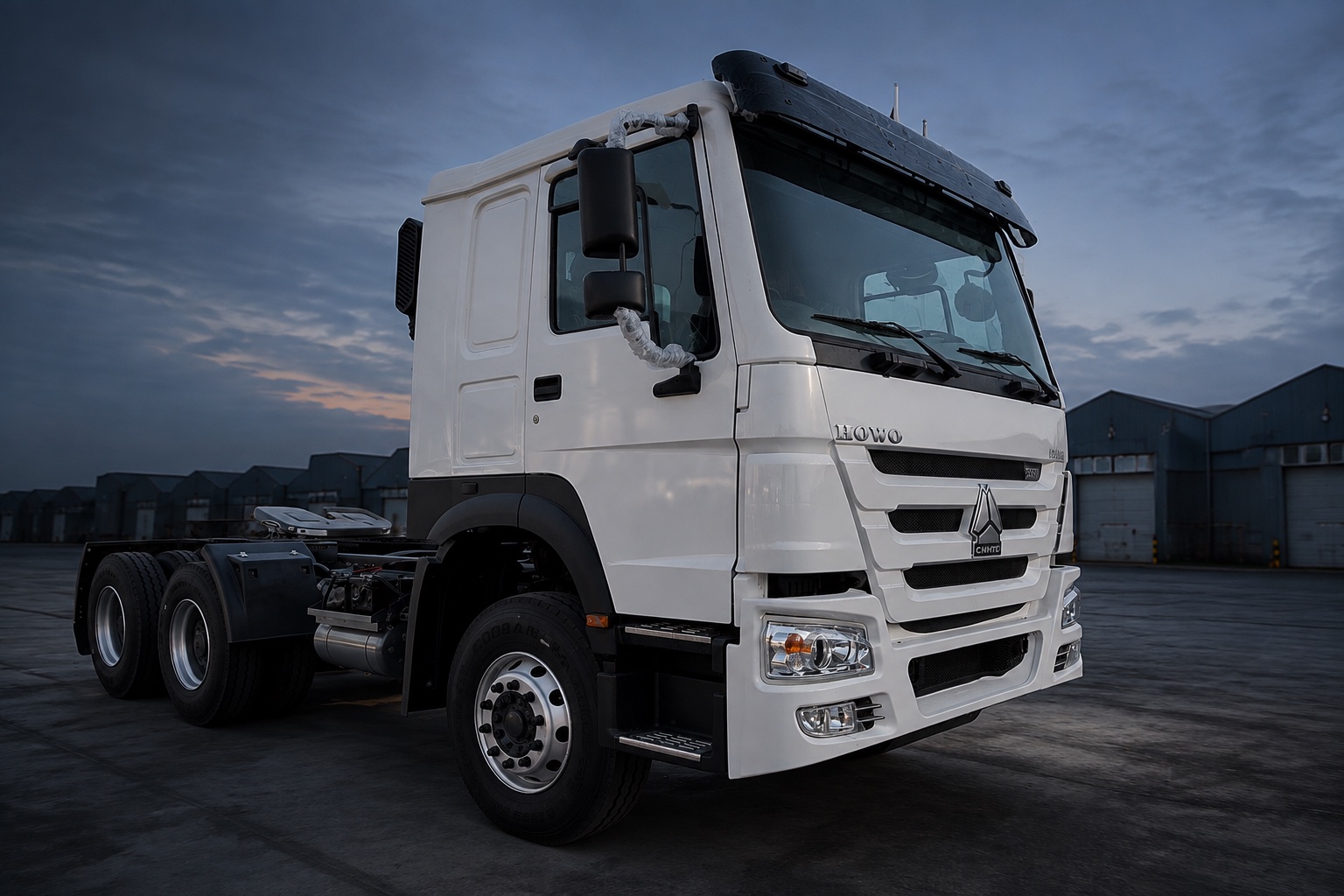
The HOWO 371 6x4 tractor is commonly offered with the HW19710 10-speed manual. This combination is familiar in many export markets and suits fleets that value straightforward operation, broad parts availability, and mechanics who already know the platform.
A 10-speed is a practical choice for regular regional haulage, mixed road conditions, and operators whose loads and routes do not change dramatically each day. Fewer ratios can mean fewer shifts in traffic or on rolling roads. That simplicity is useful when several drivers share a truck or when training time is limited.
Do not confuse simplicity with permission to underspecify. A tractor pulling heavy loads on steep corridors still needs a suitable first gear and final-drive ratio. A dump truck repeatedly starting on soft ground may need different gearing from a highway tractor even when both use a 371 hp engine. The work decides the ratio package.
When a 12-speed gearbox earns its place
A 12-speed transmission gives the driver closer ratio steps. That becomes useful when a truck runs at high gross weight, crosses long gradients, or operates across routes where speed and elevation change often. The driver can select a ratio that keeps the engine pulling cleanly without a large drop in revolutions after each shift.
Newer and higher-output tractors are commonly paired with 12-speed options. The HOWO NX 6x4 tractor is listed with a 12-speed gearbox, while the SHACMAN H3000 tractor is available with a Fast 12-speed. These trucks suit long-haul operators who want more ratio choices for varying terrain and payload.
More ratios do add driver workload in a manual transmission. A driver who skips gears intelligently on light loads can use a 12-speed efficiently. A driver who shifts constantly without understanding engine speed can waste fuel and wear the clutch. If local drivers and technicians are already comfortable with a particular 10-speed platform, changing to 12 speeds needs a training and parts plan, not just a different line on the invoice.
Manual or AMT is a separate decision
Gear count and shift method are not the same question. Most established export configurations use a manual gearbox, but an automated manual transmission, or AMT, uses actuators and control software to operate a conventional stepped transmission. The HOWO TX 6x4 tractor offers an optional 12-speed AMT on suitable configurations.
An AMT can reduce driver fatigue, standardize shift timing, and protect the clutch from some poor habits. That is attractive for long-distance fleets with changing drivers. The trade-off is diagnostic complexity. Before choosing one, confirm that your workshop can read fault codes, source sensors and actuators, and obtain software support. A manual gearbox may be the safer commercial choice where electronic diagnosis is limited.
Axle ratio matters as much as the gearbox
The gearbox only controls part of the final drive ratio. The drive axle reduction and tyre rolling diameter determine how engine speed becomes road speed. A numerically higher axle ratio gives stronger wheel torque and easier starts, but raises engine speed at a given cruising speed. A numerically lower ratio reduces cruise revolutions, but can make starts and climbs harder when the truck is heavily loaded.
This is why copying another buyer's gearbox specification can fail. A truck that carries aggregate from a quarry needs low-speed pulling ability and frequent start performance. A tractor that spends nearly all day on flat paved roads needs comfortable cruise speed and fuel control. A SHACMAN F3000 dump truck and a highway H3000 tractor may share an engine family while requiring different axle ratios, tyres, and shift patterns.
Ask the supplier to calculate engine revolutions at your expected cruising speed using the proposed top gear, axle ratio, and tyre size. Then check that result against the engine's working range and the steepest route. This simple calculation is more useful than choosing 12 speeds because the larger number sounds premium.
Questions to answer before requesting a quote
Prepare the operating facts before comparing gearboxes:
- Truck type, body, axle configuration, and whether it pulls a trailer
- Normal payload, maximum legal gross weight, and typical start load
- Flattest and steepest routes, road surface, altitude, and desired cruise speed
- Engine model and rated torque, not horsepower alone
- Tyre size and proposed drive axle ratio
- Manual or AMT preference, driver experience, and workshop diagnostic ability
- Need for a power take-off for a tipper pump, mixer, tanker, or other equipment
- Gearbox models and spare parts already supported in your fleet
Put the agreed engine, gearbox model, axle ratio, tyre size, clutch, and power take-off details on the proforma invoice. This prevents a general phrase such as heavy-duty 12-speed from replacing a real specification.
What to inspect on a remanufactured or refurbished truck
For a remanufactured or refurbished unit, verify the transmission that is physically installed. Model plates, casing numbers, shift pattern, and power take-off position should match the contract. Check for oil leaks, casing repairs, abnormal noise, difficult engagement, clutch slip, and play in the linkage. Confirm the correct lubricant and service quantity are documented.
A road test should cover cold selection, loaded acceleration where possible, shifts through every range, reverse, and operation of the power take-off. Include those items in the pre-shipment inspection. Fresh paint cannot prove that bearings, synchronizers, air controls, or the clutch have been rebuilt.
The practical recommendation
Choose a proven 10-speed when your route, load, drivers, and local parts network favor simplicity. Choose a 12-speed when closer ratios will genuinely help a loaded truck hold momentum across changing speeds and gradients. Consider AMT only when the operating benefit is supported by local diagnostics and parts.
The final answer should name a complete driveline, not a gear count: engine, exact gearbox, clutch, axle ratio, tyre size, gross weight, route, and cruise target. That is how you buy a truck that works at the destination instead of one that merely looks stronger on a quotation.
Ruidite supplies new, remanufactured, and refurbished HOWO and SHACMAN trucks from Qingdao for export. Send us your payload, route gradients, desired road speed, tyre size, and local gearbox support, and we will help match the engine, transmission, and axle ratio before you order.
Related trucks
Ready to import with confidence?
Tell us what you need. We'll respond within one business day with specifications, FOB Qingdao pricing, and document support for your market.
Request a Quote